Saturday, January 24, 2015

Self-Management

Management is not just for managers, just as leadership is not just for leaders. We all manage, and we all lead. These are not actions reserved for only those people who happen to hold these “positions” in a company or in the society. Both management and leadership are like callings, and we all get these callings to manage and lead at different times, and to different degrees. Consider another way, we can all learn to be more self-governing through the disciplines of great management and great leadership with concepts that can give us wonderful tenets to live and work by. I have come across Twelve Rules for Self-Management which all successful people lives and works by and have achieved the greatness they in their lives. The Twelve Rules are:

1. Live by your values, whatever they are. Values guides our every decision and, therefore, our destiny. Successful people know their values and live by them. If we want the deepest level of life fulfillment, we can achieve it in only one way, and that is by deciding upon what we value most in life, what our highest values are and then committing to live by them every single day. We need to realize that the direction of our lives is controlled by the magnetic pull of our values. They are the force in front of us, consistently leading us to make decisions that create the direction and ultimate destinations of our lives. Life always has a way of testing our commitment to our values. Give yourself the gift of taking hold of this force that shapes your destiny. Spend some time to understand your values and hierarchy of values so that you are able to link up with your priorities in life and build a great system of values that gives you magnificent direction in life along-with happiness and fulfillment in living by them.


2.    Speak up! Be assertive! Ask the question! No one can “hear” what you are thinking without you be willing to stand up for it. Mind-reading is something most people cannot do. Questions change the resources available to us: In the realms of business as well as personal life questions do open up new worlds and gives us access to resources we might not otherwise realize we have available. Learning to consciously control the questions you ask will take you further to achieving your ultimate destiny than almost anything you know. Often our resources are limited only by the questions we ask ourselves.  One important thing to remember is that our beliefs affect the questions we will even consider. Many people would never have asked the question because everyone around them had told them it was impossible. They would feel it was a waste of their time and energy. Be careful not to ask limited questions, or you will receive limited answers. The only thing that limits your questions is your belief about what is possible. If you continue to ask any question, you will receive an answer. All we need to do is to create a better question and we will get a better answer. Unless you ask, you will not get the answer.

3.    Honor your own good word, and keep the promises you make. If not, people eventually stop believing most of what you say, and your words will no longer work for you. Commitment, faithfulness, trustworthiness, dependability and integrity, whatever you chose to call it, it is a powerful ingredient and a prerequisite to success. Let your “yes” be “yes” and “no” be “no”. Be true to yourself and honor your commitment. You will never achieve your predetermined, worthwhile dreams and goals without commitment.


4.     Practice gratitude. Gratitude is the antidote to fear. Be in a state of constant gratefulness. When you appreciate how far you have come, that fuels you with a positive sense of energy that will make you go even farther. So be in a state of appreciation, appreciation for how far you have come. Gratitude can magically turn your relationships into joyful and meaningful relationship, no matter what state they are in now. Gratitude can miraculously make you more prosperous so that you have the money to do the things you want to do. It will increase your health and bring a level of happiness beyond what you have ever felt before. Gratitude works as a magic to accelerate your career, increase success and bring about your dream job or whatever it is you want to do. The magical power of gratitude turns your life into gold. Gratitude operates through a Universal law, the law of attraction, “like attracts like”. The idea of gratitude can also be related to Sir Isaac Newton’s scientific discovery of “Every action always has an opposite and equal reaction”. When you apply the idea of gratitude to Newton’s law it says: every action of giving thanks always causes an opposite reaction of receiving thanks. This means that the very action of gratitude sets off a reaction of receiving. Spend at least 10 minutes in a day (preferably early in the morning) practicing gratitude and being thankful for things you have achieved in life so far.

5.   Do not expect people to trust you if you yourself are not willing to be trustworthy for them first and foremost. Trust is an outcome of fulfilled expectations. Trust is a tricky thing. When you have got someone’s trust it is great. You can sell them more stuff, get more favors, ask for more, and generally benefit a great deal. But when someone does not trust you, forget about it, you are in big trouble. Trust = Credibility + Reliability + Intimacy + Self- Orientation. Trust can be measured across four key factor, including credibility, reliability, intimacy and self-orientation. Credibility is all about what we say, our skills and credentials. Reliability is all about the actions we take and our predictability. Intimacy is tied to know comfortable people and confiding in us, and our empathy. And self-orientation is about ego.

6. Be more productive by creating good habits and rejecting bad ones. Good habits corral your energies into a momentum-building rhythm for you; bad habits sap your energies and drain you. Do not waste time in doing things which do not contribute to your goals. Do not be busy being busy. Focus on few: few friends whom you can count on, few goals in life, few programs to watch, few books to read. Be brilliant on few things, be a virtuoso, not victim. Be an artisan of your life. Obsession is the hallmark of excellence. Pick up good habits that keeps you obsessed and energized in what you do. Note down your bad habits and see the patterns in it, you can cut down on the same by consciously curbing the same. Utilize your time like a time tactician, whatever you do it well. Hard work is important but hard work should yield peak productivity. Find someone better than yourself. Learn to delegate. Think about the big picture, give them freedom.

7.    Be ethical, for it seems to be getting rare today. Curious, for those “old-fashioned” values like dependability, timeliness, professionalism and diligence are prized more than ever before. Be action-oriented. Seek to make things work. Be willing to do what it takes. At the same time live up to your reputation. Nothing is more important than your good name. Going to sleep with clear conscience. Do not lose your reputation as you get to your goals. It would take a life time to build your business/personal reputation, but it takes only 20 seconds of bad judgment for wiping that off. Never let that happen to you.

8.   Be interesting. Read voraciously, and listen to learn, then teach and share everything you know. No one owes you their attention; you have to earn it and keep attracting it. Reading a book will have many positive effects in your life. As you read a book, your creativity increases. You try to visualize the situations and characters described in the pages. Reading a good book or a good article can change your day and it will have positive effects on your mindset and way of thinking. You will attain knowledge which is the greatest power on earth. So get reading. It's a whole lot of fun. Reading will have positive effects in the future without doubt.

9. Be nice. Be courteous, polite and respectful. Be considerate. Be humble. Manners still count for an awful lot in life, and thank goodness they do. Being polite is being respectful and subtle. Being courteous is to show a helpful gesture. Be humble to show an outpouring of love for all living being and assist in any way you can, give selfless service to all without motive of any selfish gain. The law of attraction is applicable here to, like attracts like, if you are nice, others would be nice to you, similarly if you are courteous, polite, respectful, considerate and humble to others, you will get the same in return.

10.   Be self-disciplined. Self-Discipline is the ability to control one's impulses, emotions, desires and behavior. It is being able to turn down immediate pleasure and instant gratification in favor of gaining the long-term satisfaction and fulfillment from achieving higher and more meaningful goals. To possess it is to be able to make the decisions and take the actions, and execute your game plan regardless of the obstacles, discomfort, or difficulties that may come your way. Self-discipline is the fuel that gets you places. The happy by-products of discipline are success, self-respect, and improved physical and mental health.

11.  Do not be a victim or a martyr. You always have a choice, so do not shy from it: Choose and choose without regret. Look forward and be enthusiastic. Victims are frightened by change while leaders and entrepreneurs takes this as an opportunity. Work for yourself and not for your company. In case you feel you are being a victim, take a decision, leave your safe harbor of the known. While it is going to be disruptive process and you would be confused, but you will come out successful after going through the cycle of clarity, disruption and confusion. Change is always difficult to start, messy in the middle and exciting at the end. Always make a choice, do not reach to a level of expiry date for yourself as given in the food products, medicines etc. Course correct before the best before date.
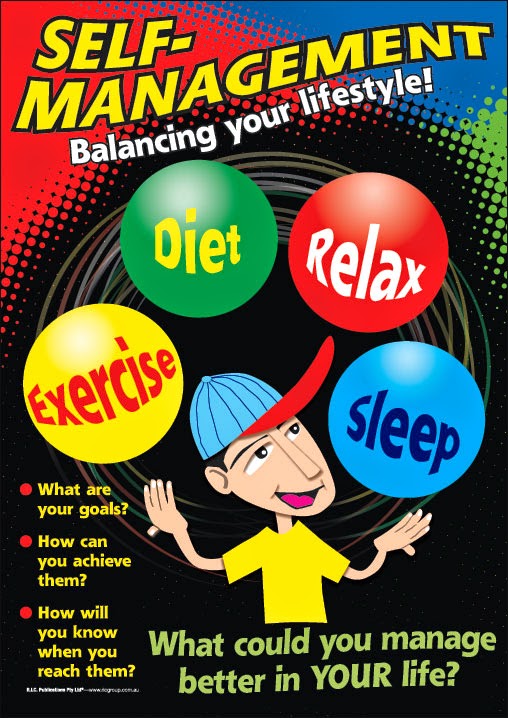
12. Keep healthy and take care of yourself. Exercise your mind, body and spirit so you can be someone people count on, and so you can live expansively and with abundance. Get to a world class fitness level. Nothing is more important than health, it is more important than your family, because If you do not have good health, you cannot be there for your family, cannot celebrate with your family. Often we take our health for granted until we lose it. When we are young we would sacrifice our health for wealth and yet when we get old and figure out what life is truly all about, we would sacrifice every penny of our wealth for one good day health. To commit yourself for self-care take care of your health. When you are in really a good physical condition life is lot more fun, lot happier.


Self-management is a critical set of skills for all to be successful in life in the face of change in so many dimensions in the life, changes that seem to happen slowly or in an instant. All human being thrive to be successful in life and one who understands his/her relationship to self-management makes it to the mountaintop.

Source: Learnings from Robin Sharma and Darren Hardy

Saturday, January 3, 2015

Leading a successful life: Fearlessness

Happy New Year to All ! Here is my blog on how to be "Fearlessness" in your success journey. Hope you find this useful.

Fearlessness

We were born to be fearless. We do not inherit fear from our ancestors. It is not an instinctive reaction, nor is it necessary for survival. One minute we can be fearless, and in the next we can learn to be fearful. For the moment let us put aside the question of whether fear has any value. The issue at hand is whether it is inborn or acquired behavior.


A parallel is drawn to explain why fear can be categorized as acquired behavior. 1. A child has no fear of spiders until she is taught to be afraid by her mother. Her first reaction to them is the instinctive one.  2. A child is afraid of the ocean, not the water itself. You can see the same child happily splashing bath water all over on numerous occasions. He must have learned to be afraid of the ocean but he has an ability to get rid of this fear in a short time. This definitely indicates a learned behavior and not an instinctive one.

The important difference is that learned behaviors, automatic or not, are capable of being unlearned or modified very quickly, whereas instinctive behaviors can only be suppressed, amplified, or redirected. Breathing is instinctive while breathing rates are learned. Eating is instinctive while food choices are learned. The urges to get warm when you are cold, get cool when you are hot, seek security when you feel insecure, or move toward or repeat pleasurable experiences, and move away from or avoid unpleasant or painful experiences are all part of human beings list of instinctive behaviors.

It is a fact, supported by research, experiments and experience, that fears can be unlearned, often quickly, without suppression, amplification or redirection. This alone puts them into the learned behavior category. We learn fear due to three vital factors: a) Self-doubt; b) Memory of pain; c) Expectation of pain.

Self-Doubt
 
Self-doubt is the most important factor, for without it fear does not occur. Self-doubt is also learned behavior. Basically, self-doubt is born when an individual interprets a feeling or sensation as meaning that one has lost contact with their source of power or love. To the degree that this interpretation is repeated with similar feelings or sensations it becomes learned and automatic behavior.


Memories of Pain

Memories of pain are present in everyone, but everyone is not affected by them in the same way. Fear is born - and eventually learned - when self-doubt is present at the time a painful experience occurs because, due to the self-doubt, an expectation of pain arises under any stimulus that resembles the original pain.

Memories of painful experience

Fear only arises in this case when a new experience reminds us of a previous painful experience and we have an expectation of another painful experience because we do not know what to do.

It does not matter if we have self-doubt, or painful memories, or fear of anything whatsoever. We learned how to act one way, however we can teach ourselves how to act differently. Self-doubt can be erased by teaching ourselves over and over and over again to trust in ourselves. To trust, not that nothing bad will ever happen, but that whatever happens we will be able to cope, and that more good things will happen than bad. The future is never fixed, but now is the moment of power. What we do and how we think in the present moment may not control the future, but it has more influence on the future than anything else. There is no fear without self-doubt. Self-doubt begins with a decision. It can end with a decision, too. To move from self-doubt to confidence, you need to embrace fearlessness.  We are our best selves when we are confident. Some of the benefits of confidence are the ability to be yourself, possessing greater courage, speaking your mind, feeling good about yourself, staying calm despite unfavorable circumstances, and having greater appeal as a friend or a mate. Confidence is byproduct of fearlessness. Hence, fearlessness is stronger than confidence. If you do not fear anything, you will naturally be confident, because a lack of confidence is primarily caused by fear of rejection, danger, or failure.

Fearlessness enables people to do unbelievable things like climb skyscrapers, launch their body across the goal line, and most importantly, boldly live their ideal life! Most people wanting to be more confident will aim directly for confidence, however they could have better success by aiming for fearlessness. In many ways, it’s a more direct approach to being more confident. When you try to be confident, you’re attempting to build yourself higher than your fears in “I can do this” kind of way.


Imagine you see a celebrity standing next to you and you want to talk to him/her, but you aren’t confident enough. To try to gain confidence at this point is going to be very difficult. Confidence comes from within, so it takes time to improve your baseline confidence. Though there are some in the moment strategies like confident body language that can physiologically increase your confidence. But what if you attempted to conquer your fears as a way to become more confident?

To conquer fear, you should first address your fear of rejection. The celebrity might respond negatively to you. If you ask him/her out, they might say no. He/she could laugh at you and embarrass you. However, these rejection scenarios are only scary or embarrassing for like 10 seconds. Can you not handle that as a worst case scenario? Are you going to let yourself be scared of 10 seconds of awkwardness or discomfort? This applies to any possible rejection scenario, from asking for a raise, to asking for a job, to asking for a financial help.

Second, you should address the fear of failure. The fear of failure is a level above the fear of rejection, and involves longer term evaluation of what the rejection means. You might feel that this one instance of rejection is representative of your asking for a job. You might feel like this job is the only job available for you, and if they do not give you a job, then all hope is lost. 

The fear of failure can be dissolved with some logic. There are 7 billion people on earth and every single one of us has different tastes and preferences. If you are a good and honest person, then most people are going to at least like you as a friend. People tend to be irrationally scared of approaching strangers. The logic is that any single case of rejection is just that – a single instance. If you are willing to keep trying, you’ll find success.
 
When you remove fear, confidence tends to emerge. Confidence is believing in a positive result, while fear is worrying about the potential of a negative result. Once fear of a negative result is gone, it’s easier to believe in a positive result (i.e. be confident). Fearlessness means nothing is holding you back. 


100% fearlessness is not always healthy though. The key in life seems to be knowing which fears are healthy and helpful to have (a fear of heights is not such a bad thing to have) and which fears simply hold you back (asking a question, trying something new, being embarrassed). Some people’s fear is so crippling that they cannot function normally. Others die because they don’t have enough fear. As with many things, balance is ideal. Be fearful of things that are worthy of your fear, but do not ever let the word “no” scare you. Do not ever let it hold you back from pursuing opportunities. Opportunities only pay off if you are willing to take them, which you can do by losing your fear and picking up confidence.

It is said that the antidote to fear is : you must make a decision to have faith, knowing you have done all you can to prepare for whatever you are fearing, and that most fears in life rarely come to being, attack that root. Then you can move forward!

To end, here is a beautiful poem “Where the Mind is Without Fear” written by Dr  Rabindranath Tagore:


Where the mind is without fear and the head is held high
Where knowledge is free
Where the world has not been broken up into fragments
By narrow domestic walls
Where words come out from the depth of truth
Where tireless striving stretches its arms towards perfection
Where the clear stream of reason has not lost its way
Into the dreary desert sand of dead habit
Where the mind is led forward by thee
Into ever-widening thought and action
Into that heaven of freedom, my Father, let my country awake.

Source: Learned Fearlessness by Robin Sharma, 

Saturday, December 27, 2014

Self Discipline

Leading a successful life: Self Discipline: No personal success, achievement, or goal, can be realized without self-discipline. It is singularly the most important attribute needed t...

Self Discipline

No personal success, achievement, or goal, can be realized without self-discipline. It is singularly the most important attribute needed to achieve any type of personal and professional excellence. Self-discipline is the ability to get yourself to take action regardless of your emotional state.


Imagine what you could accomplish if you could simply get yourself to follow through on your best intentions no matter what. The pinnacle of self-discipline is when you reach the point that when you make a conscious decision, it’s virtually guaranteed you will follow through on it.

Self-discipline is one of many personal development tools available to each one of us. The problems which self-discipline can solve are important, and while there are other ways to solve these problems, self-discipline absolutely shreds the problem. Self-discipline can empower you to overcome any addiction or lose any amount of weight. It can wipe out procrastination, disorder, and ignorance. Within the domain of problems it can solve, self-discipline is simply unmatched. Moreover, it becomes a powerful teammate when combined with other tools like passion, goal-setting, and planning.

What is Self-discipline?

It is the ability to control one's impulses, emotions, desires and behavior. It is being able to turn down immediate pleasure and instant gratification in favor of gaining the long-term satisfaction and fulfillment from achieving higher and more meaningful goals.

To possess it is to be able to make the decisions and take the actions, and execute your game plan regardless of the obstacles, discomfort, or difficulties that may come your way. 

Certainly, being disciplined does not mean living a limiting or a restrictive lifestyle. Nor, does it mean giving up everything you enjoy, or, to relinquish fun and relaxation. It does mean learning how to focus your mind and energies on your goals and persevere until they are accomplished. It also means cultivating a mindset whereby you are ruled by your deliberate choices rather than by your emotions, bad habits, or the sway of others. Self-discipline allows you to reach your goals in a reasonable time frame and to live a more orderly and satisfying life.  


Celebrities have never been more visible in our culture. Famous sportspeople, wonderful actors, and musicians are all over the media. While they are naturally talented, but what we don't see are the thousands of hours of super-focused work these people have put in behind the scenes. Sure, there is such a thing as natural talent but:  
1.       Natural talent counts for little unless it's supercharged by self-discipline.
2.       Self-discipline can, to some extent, overcome lack of natural talent.

Exercising self-discipline can make the difference between an averagely talented person doing something amazing with their lives and a naturally talented person realizing very little of their potential. It's easy to feel that success comes easily; that it's just a question of self-belief. But anyone who has achieved anything has done so because they've been able to control and direct their own inner lives and actions to the extent that has enabled them to become super-able at what they do.
Life isn't some waiting room in which to 'kill time' with repetitive self-amusements. Self-discipline, like a muscle, can be developed. If we were raised in a disciplined environment, we may find it easier to be self-disciplined, but we can all develop more.

How to develop Self Discipline?

Start with small steps: No process takes place overnight. Just as it takes time to build muscle, so does self-discipline. The more you train and build it, the stronger you become. In exercise, if you try to do too much at once, you could injure yourself and have a setback. Likewise, take it one step at a time in building self-discipline. So, begin by making the decision to go forward and learning what it takes to get there. Learning self-discipline in the little things of life prepares the way for big successes. On the other hand, those who are undisciplined in small matters will likely be undisciplined in more important issues. Small daily steps over time leads to giant successes.

Get yourself organized: Make a schedule, however detailed or general you are comfortable with, and stick to it. Have a to-do list of things you need to accomplish. Using a daily planning book or a personal information manager program on your computer or your smart phone would be helpful. But get organized, even if all you do is jot down appointments and to-do items on a piece of scrap paper. The simple reality is that if you don't control your time, everything (and everyone) else will.

Learn what motivates you and what pulls you down:  You can begin by learning about yourself! Sometimes it is very difficult to fight off urges and cravings, so know the areas where your resistance is low and how to avoid those situations.  If you know you cannot resist cake, fries, or other temptations - stay away from them. Do not have them around to lure you in moments of weakness.  If you also know that putting pressure on yourself does not work for you, then set yourself up in an environment that encourages the building of self-discipline rather than one that sabotages it. Remove the temptations and surround yourself with soothing and encouraging items such as motivating slogans and pictures of what you want to achieve. 
Learn also what energizes and motivates you. Your willpower can go up and down with your energy levels so play energetic music to perk you up, move around, laugh, go for a walk in the nature. Train yourself to enjoy what you are doing by being energized. This will make it easier to implement desirable and appropriate behaviors into your routine - which is really what self-discipline is all about. 


Make certain behaviors a routine: Once you have decided what is important to you and which goals to strive for, establish a daily routine that will help you achieve them. For example, if you want to eat healthily or lose weight; resolve to eat several servings of fruits and vegetables each day and exercise for at least half an hour. Make it part of your daily routine and part of your self-discipline building. Likewise, get rid of some of your bad, self-defeating habits, whatever they may be. They can put you in a negative frame of mind and hinder your self-discipline. A poor attitude can also be a bad habit.  If you start something, finish it. Therein lies an important key to developing self-discipline.
When you have free time, do things that are productive instead of merely entertaining. Read a good book, listen to music, take a walk, or have conversation with someone. In other words, learn to entertain yourself with things that are challenging, stimulating, and creative. Things that are of no value except to entertain you make a very small contribution to your well-being.

Practice self-denial: Learn to say no to some of your feelings, impulses and urges. Train yourself to do what you know to be right, even if you do not feel like doing it. Skip dessert some evenings. Limit your TV watching. Resist the urge to yell at someone who has irritated you. Stop and think before you act. Think about consequences. When you practice self-restraint it helps you develop the habit of keeping other things under control. Be honest with yourself. Honesty can be hard to take. Harder, in fact, than actually doing the thing you're trying to avoid. Stop mistaking excuses for credible reasons.
Remember the words of Abraham J. Heschel:“ Self-respect is the fruit of discipline; the sense of dignity grows with the ability to say no to oneself”
Other people can exert an immensely negative effect, if we let them. Don't let them. Don't let words or even negative facial expressions deter you. Seek the advice of experts by all means and learn from the best, but never accept negativity from people who haven't themselves achieved what it is you are set upon achieving. If people say what you plan is not possible or sneer at your efforts, don't be deterred by this; rather, use it to fire your energy and strength. Proving others wrong is a greatly underrated pleasure.


Engage in sports or physical activities: Sports are an excellent way to enhance self- discipline. They train you to set goals, focus your mental and emotional energies, become physically fit, and to get along well with others.  Participating in sports provides a situation where you learn to work hard and strive to do your best, which in turn, teaches you to integrate the same the thought processes and disciplines into your everyday life. Similarly running is also an excellent way to enhance self-discipline. It trains your body and makes you physically fit and build endurance.
Learning to play a musical instrument can be another great way to practice self-discipline. The focus, repetition, and application required in learning to play an instrument is invaluable. Achieving self-discipline in any one area of your life reprograms your mind to choose what is right, rather than what is easy.

Get inspiration from those you admire: Sachin Tendulkar has always maintained that his greatness as a cricket player came as much from his willingness to work hard at his craft, as it did his talent. It was his desire through discipline and focus that made him one of the world’s greatest cricket player ever. If it worked for him, it could certainly work for the rest of us. 

Visualize the rewards: There is nothing more gratifying than accomplishing your goals. Practice the technique that high achievers and top performers do. Project yourself in the future. Visualize your desired goal. Feel how rewarding it is and the countless benefits you will enjoy. Remind yourself what it takes to get there. 


If we are to be masters of our own destiny, we must develop self-discipline and self-control. By focusing on long-term benefits instead of short-term discomfort, we can encourage ourselves to develop of self-discipline. Ultimately our health and happiness depend on it. Self-discipline is the fuel that gets you places. The happy by-products of discipline are success, self-respect, and improved physical and mental health.
                                 

Sources : Learnings from Robin Sharma, Darren Hardy, Brahmarishi Shri Guruvanand ji Swamy, Grant Cardone


Saturday, December 20, 2014

Values

Values guides our every decision and, therefore, our destiny. Successful people know their values and live by them. If we want the deepest level of life fulfillment, we can achieve it in only one way, and that is by deciding upon what we value most in life, what our highest values are and then committing to live by them every single day. Unfortunately this action is far too rare in today's world. Too often people have no clear idea of what's important to them. If you and I are not clear about what's most important in our lives or what we really stand for, then how can we ever expect to lay the foundation for a sense of self-esteem and have the capacity to make effective decisions? When you know what's most important to you, making a decision becomes quite simple and easy.

We need to realize that the direction of our lives is controlled by the magnetic pull of our values. They are the force in front of us, consistently leading us to make decisions that create the direction and ultimate destinations of our lives.

In our personal and professional lives, we must be clear about what is most important in our lives and decide that we will live by these values, no matter what happens. This consistency must occur regardless of whether the environment rewards us for living by our standards or not. We must live by our principles even when it "rains" even if no one gives us the support we need. The only way for us to have long term happiness is to live by our highest ideals, to consistently act in accordance with what we believe our life is truly about.

Many people know what they want to have, but have no idea of who they want to be. Getting "things" simply will not fulfill you. Only living and doing what you believe is the "right thing" will give you that sense of inner strength that we all deserve.

To value something means to place importance upon it: anything that you hold dear can be called a 'value'. Those things that are most important to you in life are referred to as life values. Life values are of two types: ends and means. So if someone were to ask you, what do you value most? You might answer "love, family, money etc." Of these love is the end value you are pursuing, in other words, the emotional state you desire. Conversely, family and money are merely means values.

The challenge in life is that most people are not clear on the difference between means and ends values and therefore, they experience a lot of pain. So often people are too busy pursuing means values that they don't achieve their true desire: their end values. The end values are those that will fulfill you, make your life rich and rewarding. Here is an example which would clearly demonstrate what is meant by means and ends values. Let’s say a man’s highest value are caring and contribution, and he chooses to become a lawyer because he once met a lawyer who really impressed him as being able to make a difference and help people through his work. As time goes by, he gets caught up in the whirlwind of practicing law and aspires to become a partner in a firm. As he pursues this position, his work takes on an entirely different focus. He begins to dominate and becomes one of the most successful man you know, yet he feels unhappy because he has no longer any contacts with the clients. His position has created a different relationship with his peers and he spends all her time in meetings ironing out protocol and procedure. He achieved his goal but missed out on life’s desire. In order to be truly happy, we must know the difference, and be sure to pursue the end itself.

While it is absolutely true that everyone are constantly motivated to move towards pleasurable emotional states, it is also true that we value some emotions more than others. For example, what are the emotional states that you value most in life? What are the emotions that will give you the most pleasure? Love or Success? Freedom or Intimacy? Adventure or Security? These are pleasurable states that we value most because these are the emotional states we will do the most to attain. What are some of the feelings that are most important for you to experience in your life on a consistent basis? It is certainly true that we probably value all these emotions, and that they are all important for us to feel. However it would be fair to say that we don’t value all of them equally. There are some emotional states that we will do more to achieve than others. Actually, we all have a hierarchy of values.

Remember, whatever your values are, they affect the direction of your life. We have all learned through our life’s experience that certain emotions give us more pleasure than others. Knowing your own values helps you to get more clarity as to why you do what you do and how you can live more consistently, but knowing the values of others is also equally important. It might be valuable to know the values of someone you are in relationship with, or somebody you are in business with. Knowing a person’s value give you a fix on their thought process and allows you to have insight into their decision making. Further knowing your own hierarchy is also equally critical because your top values are those that are going to bring you the most happiness. If you do not know your own hierarchy, you will experience what seems like an inexplicable feelings of unhappiness and emptiness.

Just as there are emotions we desire to experience because they are pleasurable and that is why we are always moving towards them, we also have a list of emotions that we will do almost anything to move away from. We must remember that any time we make a decision about what to do, our brain first evaluates whether that action can possible lead to either pleasurable or painful states. Our brain is constantly juggling, or weighing our alternatives to see what the impact may be, based upon our own value hierarchy. The relative levels of pain or pleasure we associate with certain emotions will affect all of our decisions.

Life always has a way of testing our commitment to our values. Give yourself the gift of taking hold of this force that shapes your destiny. Spend some time to understand your values and hierarchy of values so that you are able to link up with your priorities in life and build a great system of values that gives you magnificent direction in life along-with happiness and fulfillment in living by them.

To sum it up, would share the following lines from John Wooden: “Be more concerned with your character than your reputation, because your character is what you really are, while your reputation is merely what others think you are.”

Source : Learning from Robin Sharma and Tony Robbins

Saturday, December 13, 2014

Energy

Energy is one of the important ingredients for success. Energy can be both positive and negative, for being successful it is essential that you always be full of positive energy and same should be exploding out of you. You should always keep yourself surrounded by people with positive vibes. Both these types are nothing but a state of mind. Positive energy empowers you to perform at world class level, while negative energy is always instrumental in pulling you down in other direction and taking you off-track. Once you start allowing negative energy to make inroads into your mind and soul it requires immeasurable efforts to come out and get yourself to positive frame of mind. It is said that to overcome one influence of negativity you need to make hundred times more effort to convert your state of mind towards positive frame. In next few paragraphs I will be sharing some thoughts on how to keep your energy levels explosive and full of positive vibes. Energy levels influences each action you take day in and day out. Without high level of energy opportunities would remain untapped.

Ideas remain untapped and unrealized. All successful people have high level of energy, high levels of energy allows them to wake up early in the morning without feeling exhausted; allows them to be on their own; allows them to work hard; allows them to play at their best, allows them to have fun and enjoy life and see it as a rich adventure. High level of energy also allows them to handle adversity and keep them optimistic and stay positive at all times.
See the lives of all great people, be it Sir Richard Branson, Mahatma Gandhi, Thomas Edison, Mother Teresa, Benjamin Franklin, to name a few, these great people have demonstrated that you cannot be a leader if you do not have high level of energy.

Do not drag yourself out of the bed rather wake up with high energy. Do not keep dreaming rather build dreams which are so big that keeps you awake with high level of energy in pursuit of your dreams. Few inputs on how to create energy explosion in your life:

1. Clarity and World Class Planning:
Clarity precedes success. When you have meaningful goals and a clear direction in your life, that will not only promote greater sense of hopefulness but you will feel more energized. Great Goals brings energy to your life. Setting goals boosts your energy. It gives a reason to get out of bed every day. The secret of passion is purpose. The cause has to be higher than self. As the saying goes time and tide waits for none.  Time slips through our fingers as grains of sand, never to return again.


When you set goals for every part of your life, you will feel energized as better clarity leads to better decision and better results. Writing things down on a piece of paper clarifies fuzzy thinking and gives better awareness  and better clarity and better awareness and clarity leads to better choices and better choices leads to better results. What is not measured is never improved. Getting clarity over the philosophy of your life and what your life would stand for and breaking down that philosophy into specific and measurable goals for each core area of your life will connect you to the giant source of energy, passion as well as the focus that resides within you. Clarity and world class planning is the key ingredients for success.

2. Get up early and work on yourself: When you get up early on a consistent basis you will find yourself with more energy rather than less energy. Your conscience watches everything you do. Getting up early helps create better self-esteem and self-discipline. People who feel good have high level of energy. Win the battle with the bed, mind over mattress.  Getting up early is the primary win for yourself, this is the first victory of your first goal. If you are serious in working on yourself, follow the following tips:

a) Do not eat after 7.00-7.30 pm;

b) Do not watch the news or spend time on your mobile or your tab before you go off to sleep, remember it’s not the quantity of sleep that is important, it’s the quality of sleep that matters. Before going to sleep, spend moments in silence, do some thoughtless breathing, think of positive things, results of this would be a better and sound sleep and you wake up next day with abundant energy;

c) Sleep early by 10pm/11pm. You cannot burn the candle on both ends. Human being are remarkable to adopt, create your new normal. Take 60 minutes for yourself every day, read some inspirational book, journaling and record your learning from previous day, meditate and spend time on spirituality, be in the moment and enjoy the journey of life. You can also use affirmative success statements like "every day and in every way I am getting better and better healthier and healthier" or "I am joyfully living in the moment and am being at my best", Spending time with nature is another wonderful way to energize, visualize and work on your attitude. Focus on the good things in life, will keep you positive, work on your personal philosophy.
 
Give yourself some time to settle to this schedule, research has suggested it takes 66 days to form a habit, be persistent with it and you can do it.

3. Consistent exercise and high performance diet: Exercise boosts energy. When you are in world class physical condition you can get to your goals and missions in life as you are full of energy. The price of discipline is much less than the pain of regret.
 
You can plan for your exercise to cover the three aspects of cardio, weights and stretching. Exercise makes you happy and boosts energy. Exercise has to be vigorous. When you are strong physically you are strong internally. In a relaxed body remains a relaxed mind.

A high performance diet is a critical success factor for getting a high level of energy. When the diet is impeccable, you have boundless energy. There is such a link between what you eat and how you feel. If you eat a big meal, you are going to get exhausted and your creativity diminishes, high energy falls apart mental clarity and thus impacting you professionally, personally and your inner life. Successful people always maintains the following in their diet:

a. Drinks a lot of water, water hydrates your brain;

b. Drinks fresh fruit juices;

c. Portion control -eat less food, will allow more energy for you;

d. Don't eat after 7.00 -7.30 pm, if you eat late at night all night your food is being digested, you will wake up feeling exhausted and the results of the following day will be much less than what you desired and planned.


4. Personal regeneration and renewal: We live in a world where most people go full out in their work. Too many people takes vacations as a waste of time or unproductive time. There is a parallel which is so very true, if you were to run your car at full speed for next seven days, what is going to happen to that car, it’s going to break down, it’s going to wear out and it’s not going to perform at its best. High performers in the playing field of life understand that metaphor and they run their life in cycles, they balance perfectly well between playing their best game in professional or work life and personal regeneration/renewal. High performers balance is being ”on game" I.e. playing full out and being at your best with periods of recovery. There is a misperception around 'stress', there is nothing wrong with stress, stress makes you play your best game, it marshals your best resources, the real problem is most people do not take time out to recover from stress, they are  always working, they are always rushing, their minds are always in million places at a single time, we do need recovery time, as shared in the car metaphor, if you don't take time to recover, you will break down, you will  get tired, you will get to a place where you will be unproductive and you are frustrated. Build time for recovery and renewal, time to relax, time to regenerate, time to bring back the balance, when you take time for personal recovery, you will actually become more productive with explosive energy levels, and you can do far more in less time.

5. Adventure and Fun in life: Human brain craves novelty, most of us cling to the safe harbor of the known, we try to do the same thing with same people day in and day out and resist any change. We think that our life would be happy, safe and secured without realizing that this is a recipe for disaster. That’s the most insecure place to be in. We are happiest when we are adventurous, we are not happy when we are at the safe harbor of the known, we are happiest when we are trying new things, meeting new people and pushing our personal frontiers. The greatest risk you can ever take in life is not taking any risk. To have world class energy you need to institutionalize adventure and fun into your life by building a system around it. Plan one day every week as a Play day for adventure and fun.

Get back to being a kid, connect with the child that resides within each and every one of us, that's a great way to release the world class level of energy lived within you. Say no to negative energy and influences, embrace positive thoughts as a way of life, weed out all negative influences and people around you. If you apply the above thoughts into your life, I am sure of your meeting success in whatever you do. Energy is the most important and powerful ingredients for success.

As the saying goes, “Some people want it to happen, some wish it would happen, others who succeed make it happen!”

Sources: Learnings from Robin Sharma and discourses by Pt. Vijay Shankar Ji Mehta